The arid expanses of Arrakis demanded formidable transport, and when Dune: Awakening launched its Chapter 2 update with the Lost Harvest DLC, a new mechanical beast emerged—the Treadwheel. This ground vehicle promised sharper turns and blistering acceleration compared to the standard Sandbike, instantly becoming a coveted asset for survivors crossing the Hagga Basin's shifting sands. Yet obtaining it wasn't as simple as purchasing the DLC; it required navigating treacherous missions and intricate crafting systems that tested even veteran Fremen.
🔍 The Path to Schematics
Players quickly discovered that the Treadwheel's blueprints remained locked behind the Lost Harvest storyline. Four sequential missions stood between them and the prize: The Fall of Mithra tested combat prowess, Villari's Prize demanded stealth, Digging Deeper challenged survival instincts, and finally, Secrets of the Past unveiled ancient technologies. Completing this last mission automatically rewarded the Treadwheel MK4 schematics—alongside upgraded modules like Inventory MK2 and Boost MK4. As one guild leader noted, "The desert doesn't give gifts; it demands payment in sweat and strategy."
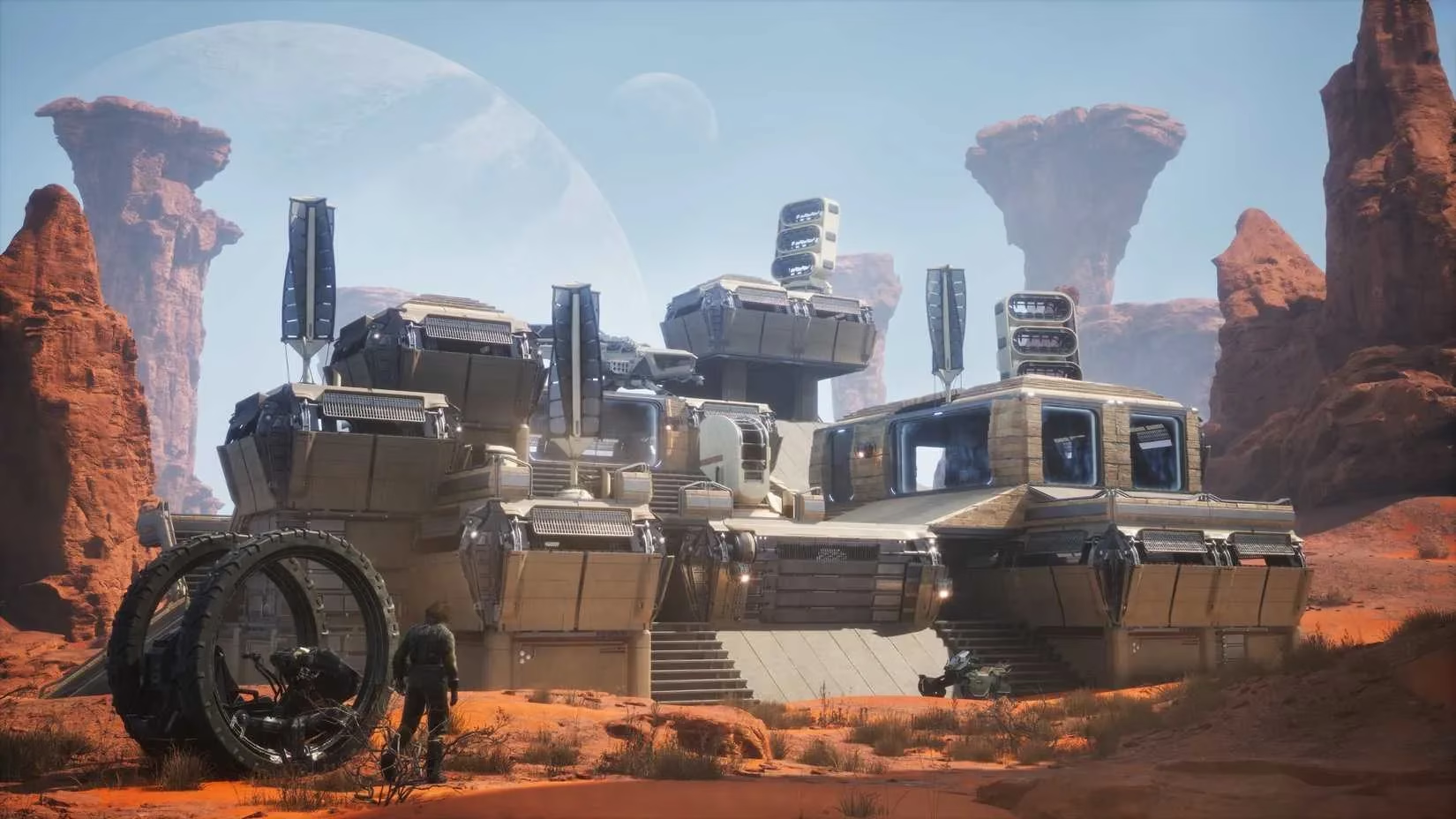
⚙️ Crafting Variants & Sacrifices
Three distinct Treadwheel models awaited crafters:
-
MK4: Baseline model (unlocked via DLC missions)
-
MK5: Requires 45 Research Intel Points
-
MK6: Demands 60 Research Intel Points 💡
Resource gathering became a desert-wide obsession. Crafting any variant consumed:
| Component | Common Materials | Rare Materials |
|---|---|---|
| Chassis | Reinforced Steel x20 | Spice Resin x5 |
| Engine Core | Electro-Circuits x15 | Crysknife Shards x3 |
| Suspension | Polymer Weave x30 | Stilltent Alloy x8 |
A critical choice haunted builders: equipping either the inventory expansion module for hauling relics or the boost module for escaping sandworms—never both. This duality mirrored life on Arrakis itself: security versus speed, pragmatism versus thrill.
💸 DLC-Free Acquisition Tactics
For those refusing the DLC, three ingenious paths existed:
-
Player Markets: Arakeen and Harko Village trade hubs occasionally listed Treadwheel parts under "One-Man Ground Vehicles," though prices often soared to 10,000+ Solari during peak demand 📈
-
Friendship Economy: Allied players with the DLC could craft components like the Gyro-Stabilizer or Thermal Exhaust and simply drop them—a practice that spawned entire part-bartering communities
-
Guild Shares: Large factions often designated "communal Treadwheels," granting co-ownership rights to trusted members 🏜️
❓ People Also Ask
-
"Can MK6 outrun a Shai-Hulud?" Tests showed Boost MK4 gave a 3-second headstart—barely enough to reach rock outcrops
-
"Is inventory capacity worth losing boost?" Resource hunters swore by extra storage, while deep-desert scouts called boost "the difference between respawning and surviving"
-
"Do treads handle spice blows better?" Wider surface area reduced sinkage by 40% compared to Sandbikes
🌅 The Greater Paradox
As guilds now dominate the deep desert with fleets of MK6 variants, a question lingers beneath Arrakis' twin moons: In a world where vehicles dictate survival, does communal sharing erode the scarcity that makes survival meaningful? Perhaps the true test isn't unlocking schematics—but deciding whether faster treads lead to richer experiences, or merely quicker escapes from what makes Dune... Dune. 🐛
The analysis is based on GamesIndustry.biz, a leading source for market trends and developer insights in the gaming sector. Their recent features on player-driven economies and DLC integration shed light on how new content like the Treadwheel in Dune: Awakening not only enhances gameplay but also stimulates in-game trading and community collaboration, reflecting broader industry shifts toward player agency and emergent social systems.