As I ventured deeper into the vast, unforgiving deserts of Dune: Awakening, my journey took a distinct turn northward. Having secured the basic necessities for survival, my focus shifted to more specialized resources required for advanced crafting and progression. Among these, the Agave Seed stood out—a vital component that promised to unlock new tiers of technology and sustenance. Unlike the perilous hunts for Spice in the deep desert or the frantic scrambles for salvage in the contested zones, the quest for Agave Seeds presented a different kind of challenge. It wasn't about surviving an immediate, violent assault, but about navigating the subtler dangers of distance and exposure in a world where the environment itself is a relentless adversary. My destination was clear: the O'odham region, a stretch of land lying between the relative safety of Mysa Tarill and the imposing, cliff-like barrier of the Western Shield Wall. This journey was a calculated step in my evolution on Arrakis, moving from a mere survivor to a gatherer of the planet's unique botanical wealth.
Navigating to the Agave Seed Fields
Pinpointing the exact location was my first task. The O'odham region isn't a single point but a broad area. I found that by carefully examining my in-game map and zooming in sufficiently, I could actually spot the icons representing Agave Seed clusters. This was a welcome relief; not all resources in Dune: Awakening are so conveniently marked, forcing players into blind exploration. The region itself is characterized by its stark, beautiful desolation. It's far enough north to feel distinct from the starting zones, with rock formations beginning to hint at the proximity of the Shield Wall, yet it lacks the constant, frenetic energy of the deep desert or the Spice fields. The primary threats here are environmental: the ever-present heat, the potential for sudden Coriolis storms, and the ever-watchful Shai-Hulud, whose tremors can be felt even in these outskirts. However, compared to the violent, player-versus-player skirmishes common near key resource nodes, the O'odham region felt almost serene—a place for methodical gathering rather than frantic combat.
Identifying the Prized Flora
Upon arriving in the region, the next challenge was identification. The desert is full of flora, most of it hostile or inedible. Agave Seeds are not found on the common, barrel-shaped cacti. Instead, they are borne by a specific flowering plant. After some initial searching, I learned to spot its distinct silhouette against the horizon. The plant grows as a tall, mostly vertical spire, culminating in a distinctive flowering structure at its very apex. This spire-like growth habit makes it stand out from the more rounded and sprawling cacti surrounding it. Seeing it for the first time was a moment of quiet triumph. Here is what it looks like in the wild:
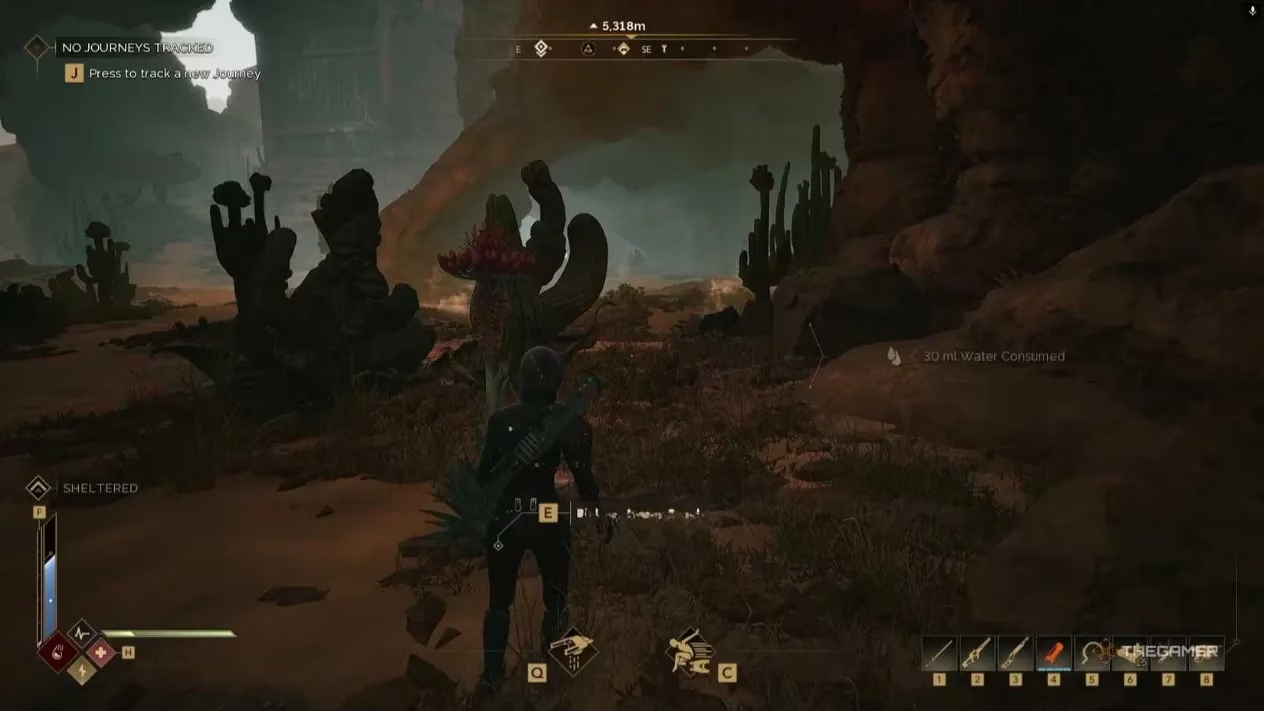
The plant's appearance is crucial knowledge. While the seeds are "found abundantly" in the region as the guides say, the plants themselves are not packed densely together like a field of wheat. You won't find a hundred of them in one glance. Their distribution is sparse, requiring a patient, observant eye and a willingness to traverse the rocky terrain to locate each one. A successful harvesting run is less about a single, bountiful spot and more about connecting the dots between these isolated botanical spires.
The Harvesting Process and Strategic Considerations
The actual act of harvesting the seeds is straightforward. A simple interaction is usually all it takes to add them to my inventory. The real strategy lies in the journey and preparation. Here’s a breakdown of my standard approach:
-
Preparation Checklist:
-
Water, Water, and More Water: The trek north and the time spent searching is a major hydration drain. I never leave without a surplus.
-
Temperature Regulation Gear: Insulated clothing or a stillsuit upgrade to manage the daytime heat.
-
Navigation Aids: Map markers are essential for plotting a efficient, looping path to maximize yield.
-
Light Armor & A Weapon: While not a warzone, one must always be prepared for opportunistic players or the occasional hostile creature.
-
-
Optimal Harvesting Route: I don't wander aimlessly. I plot a wide, circular route through the heart of the O'odham region, using the map icons as waypoints. The goal is to end the loop near my starting point or a safe shelter.
-
Yield Expectations: It's important to manage expectations. A single plant provides a modest amount of seeds. To gather a "good number" for meaningful crafting—perhaps a batch of advanced medical supplies or a component for moisture-farming tech—I plan for a harvesting session that covers 10-15 plants. This requires time and patience.
Why Agave Seeds Matter: From Botany to Blueprints
So, why go through this trouble? The value of Agave Seeds in Dune: Awakening is multifaceted. They are not a mere commodity for trading; they are a fundamental ingredient for mid-to-late-game advancement. Their primary uses, based on my experience and the game's crafting systems, include:
| Use Case | Description & Importance |
|---|---|
| Advanced Medical Items | Used in synthesizing antitoxins, advanced healing stimulants, and regenerative compounds. Vital for surviving venomous creatures or prolonged expeditions. |
| Biochemical Crafting | A key reagent in creating organic adhesives, non-metallic polymers, and specialized lubricants needed for vehicle and tool maintenance. |
| Nutritional Supplements | Can be processed into high-density nutrient pastes that provide sustained energy with less water cost than standard rations. |
| Moisture Farm Components | Certain botanical extracts from the seeds are used in the filters and condensation catalysts of advanced moisture traps. |
In essence, securing a reliable supply of Agave Seeds transitions my gameplay. It moves me from scavenging what I need to producing what I need. It's the difference between being a tenant on Arrakis and becoming a settled inhabitant who understands and utilizes its ecology.
Reflections on a Peaceful Harvest
My expeditions to the O'odham region have become some of my most cherished moments in Dune: Awakening. In a game dominated by the visceral thrill of spice harvesting, the tension of stealth, and the chaos of open conflict, the Agave Seed run is a deliberate, peaceful interlude. It’s a journey that emphasizes observation, preparation, and respect for the landscape. The silence is broken only by the wind and the crunch of my boots on gravel. The risk is not from a sudden laser blast, but from the slow, insidious drain of the sun or the distant rumble that signals a worm's approach, reminding me that no place on Arrakis is ever truly safe. Yet, there's a profound satisfaction in successfully navigating these quieter dangers and returning to my base with a satchel full of these precious botanical seeds, ready to be transformed into the tools that will ensure my continued survival and growth on this magnificent, deadly planet. It's a reminder that life, in its most resilient forms, persists even here, and that understanding it is the key to thriving.