The sand stretches endless and golden, each dune a wave frozen in time, and somewhere across that barren majesty a stranger walks. They have crossed the Shield Wall, tasted the bitter tang of spice on the wind, and listened to the deep thrumming that heralds a worm's approach. In Dune: Awakening, the desert does not merely exist as scenery—it breathes, it hungers, it shapes every choice. To survive, one must wear the stillsuit, that faithful second skin which reclaims every bead of moisture the body surrenders. Yet for all its life-preserving genius, the stillsuit carries one small cruelty: it hides the face. A face crafted with patience. A face that tells a story of chosen marks, of eyes that have seen the dream-visions of the spice. For the wanderer who wishes to feel the sun on their virtual skin and see their own countenance reflected in a water-seller's cistern, there is a way. The helmet may be dismissed with a gesture as simple as a breath held before a sandstorm.
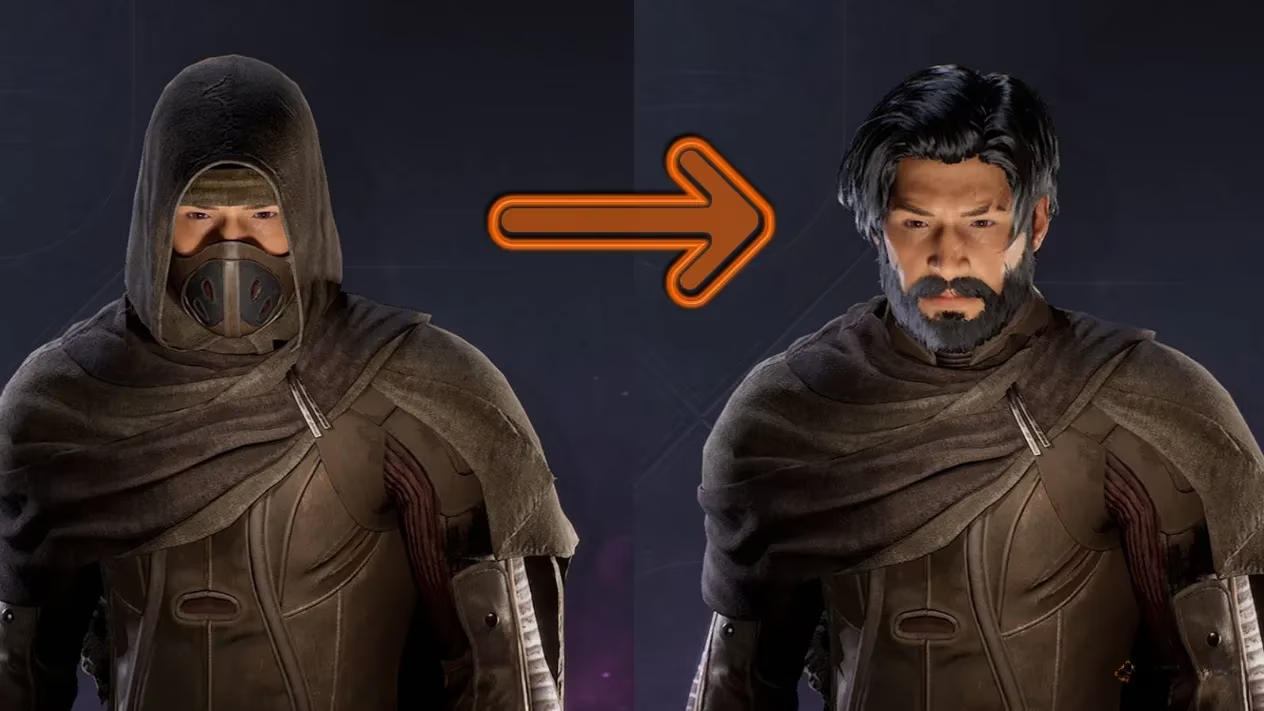
The journey to reveal one's true visage begins not in the deep desert, but in the quiet space of the inventory—a digital book of all that is carried, collected, and worn. Every traveler on Arrakis knows this place well. It holds the stillsuit, the maker hooks, the glow-globes, and the weight of a thousand scavenged moments. From here, one can peer into an expanded view, a hidden room within the inventory that few pause to explore. The command is a single key, a quiet tap on the 'D' key, and the screen unfolds like a Fremen map. There, beneath the wearer's boots on the leftmost column of equipment, lie words that are barely more than a whisper: Helmet. Beside it, a humble checkbox, ever so lightly waiting to be untouched. To uncheck that box is to dissolve the mask like morning mist on the rocks of Sietch Tabr. The face returns. The lips, the brow, the cheekbones shaped with the care of a sculptor—all stand free once more.
Some know this trick from the very beginning. Others stumble upon it after days of wondering why their beautiful character, with eyes tinted by the Eyes of Ibad effect—that deep, luminous blue born of prolonged spice consumption—never truly got to see the light of Arrakeen. Those ethereal eyes, too, can be toggled off from this same quiet menu. Perhaps the wanderer wishes to remember what they looked like before the spice changed them forever. Perhaps they simply want to appear in a photograph, a memory captured in the sands, without looking like a creature of legend. Whatever the reason, the power sits patiently in the inventory. It asks for nothing but a decision.
Yet readers must know a secret of this world, a capricious truth: the cutscenes care little for your choices. When the great moments of story unfold—when blades clash over ancestral grudges, when the Shai-Hulud passes beneath and the ground sings its hymn—the game often decides for you. For the most part, your helmet will be hidden during these cinematic passages, as if the director of this desert opera wants you to see the fear and longing in your character’s eyes. But at other times, even with the checkbox dutifully cleared, the mask returns. It sits upon the face like a stubborn ghost, an automated decision woven into the code. The player might laugh at the contradiction, or perhaps feel a small frustration, knowing that their will cannot reach every corner of this simulation. And yet, in the free moments between quests, beneath the twin moons, their choice holds. The face is theirs to show.
To walk Arrakis with the helmet hidden is to feel a different sort of vulnerability. The mask was protection, a filter against the spice-laden breeze, a concession to the laws of survival. Without it, the world seems closer. Each grain of sand stings a little sharper. The conversations with quest-givers become more intimate; you can see the slight twitch of a mouth, the blinking of eyes that speak more than words. It is a small, aesthetic rebellion, yet it changes the rhythm of the journey. An offworlder might find it comfortable. A true Fremen might call it foolish, but even the natives of the desert sometimes lower their masks in the safety of the sietch. The choice is the traveler’s own.
The method, once learned, becomes second nature. A quick recall of the steps, like an old chant, can be helpful even to the most seasoned wanderer:
-
Open the inventory, that repository of all things precious and mundane.
-
Press the 'D' key to reveal the full attire and utilities, the expanded vision of what your character carries.
-
Look to the left, where items like the boots patiently rest.
-
Find the Helmet option, sitting low and unassuming.
-
Uncheck the box. Watch the mask dissolve, or reappear, as if by the wave of a Sayyadina’s hand.
The very same menu houses the toggle for the Eyes of Ibad, granting a second, subtler revelation. One might restore their original gaze, uncolored by the extensive consumption of melange, and see the character as they were before the desert claimed them. It is a quiet act of identity, a small resurrection. The game remembers these settings across sessions, a faithful scribe, so you need not redo the ritual each time you enter the world. Only when the cutscenes impose their own will must you wait, smiling perhaps, for the return of agency.
There is a poetry in this. The struggle between player agency and the authored experience mirrors the very themes of Dune—free will versus prescience, the individual versus the sweeping plan of the universe. In toggling off that helmet, the wanderer asserts a tiny, beautiful claim: I am here. I made this face. Let the desert see it. And the desert, vast and indifferent, holds no judgment. It simply allows the light to fall on the unmasked skin, just as the old imperium allowed a Duke to dream before the fall. For those who wish to capture their appearance, the photo mode becomes all the richer. Portraits can be taken at dawn, with the eyes of blue-on-blue or their natural hue, showing a soul that is not just a set of game mechanics but a presence shaped by the player’s own imagination.
Behind all of this, the Dune: Awakening developers have threaded a gentle accommodation. They understood that fidelity to the lore—where wearing a stillsuit mask is not merely cosmetic but a vital part of desert life—could clash with the human desire for personal expression. So they gave the toggle, a hidden door in the inventory, to those who seek it. They also allowed the Eyes of Ibad, those piercing sapphire windows, to be dismissed at will, blending reverence for the source material with the playful spirit of a game where players can also build their own sietch and navigate political intrigues with the Great Houses.
For those who come new to Arrakis in this year of 2026, the feature remains unchanged, a small mercy in a harsh land. Whether you are a water merchant who wishes the world to see your laughing eyes, a swordmaster whose scarred jaw tells a thousand tales, or merely a wanderer who spent half an hour in the character creator agonizing over the bridge of a nose, the option waits. Press 'D'. Uncheck the box. Breathe the unfiltered air of your own story. And when the sandworm rises behind you and the screen fades into cinematic flight, smile. Even if the helmet returns unbidden, it will vanish again as soon as the moment is over. The desert takes many things—water, time, innocence—but it cannot take away the face you have made your own.