The first time I really understood the fear, I was alone on a sea of gold. Not metaphorical gold—actual, rippling sand dunes stretching to every horizon, the twin suns of Arrakis cooking my brain. I’d only been in Hagga Basin a few hours, still fumbling with my stillsuit, still thinking I was hot stuff because I’d once killed a sand grouse with a well-placed rock. Then I saw the line. A wavy, pale thing trembling at the edge of my vision. A moment later, it turned orange. Then crimson. And somewhere beneath me, the Maker stirred.
That’s how you meet a sandworm in Dune: Awakening. Not with a handshake, but with your own heartbeat hammering in your ears as the very planet tries to swallow you. Since that day, I’ve learned to dance with the Shai-Hulud, to read the sand like a Fremen bedtime story, and—most importantly—to run in exactly the right direction. Let me tell you everything I wish I’d known before my first, humiliating, equipment-losing, blessing-spawning death.

🪱 The Earth Itself Hates You (And It’s Magnificent)
Sandworms aren’t enemies you can shoot, trick, or negotiate with. They’re an environmental hazard with a personality—an ancient, hungry personality that treats vibrations like dinner bells. The Fremen call them Shai-Hulud, the Old Man of the Desert, and the name fits. This is a creature so immense that the first time you see the big ones in the Deep Desert, the juveniles back in Hagga Basin look like angry noodles. Nothing prepares you for the scale.
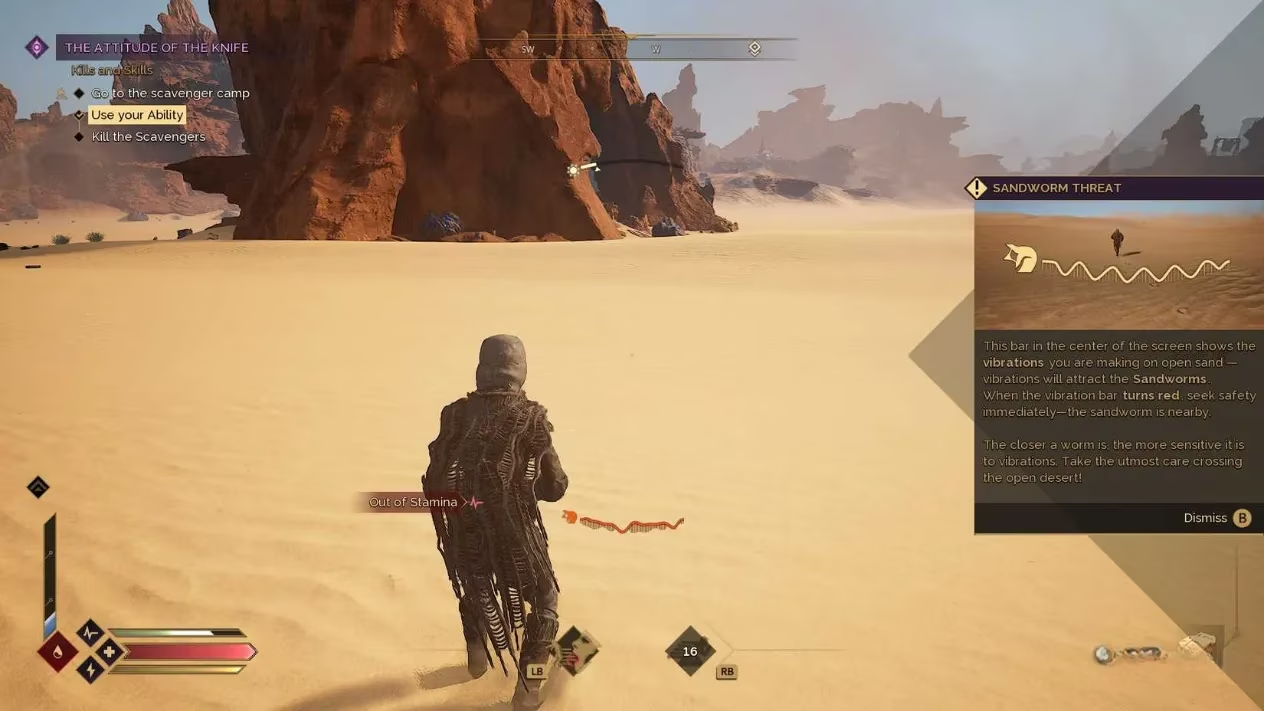
Here’s the honest truth, straight from my trembling fingers: every step you take on open sand is a conversation with a worm. Run, and you shout. Fire a gun, and you scream. Start up a vehicle, and you might as well send out engraved invitations. The sand is alive with vibration lines—those wavy HUD elements that start pale and peaceful, like a calm shore, then deepen to the colour of a warning light. Orange means “you’ve been noticed.” Red means “it’s deciding which part of you to eat first.” If you ever see that red line while standing still, I’ve got one word for you: oops.
The Vibration Tango
When you cross the open dunes, you’re not just walking. You’re cheating death with every footfall. My personal rule, honed through a dozen respawns, is to treat the first half of any crossing like a casual stroll—but the moment that bar shifts from pale gold to a sullen orange, you trigger everything you’ve got.
I learned that the hard way. One evening, loaded with spice and four crafted items I absolutely could not afford to lose, I thought I’d be clever. I’d sprint across a medium-sized dune patch using the Bene Gesserit Bindu Sprint—a glorious, burst-speed ability that makes you feel like a wind-riding goddess. I used it immediately. Ten seconds later, the worm was under me, the bar was redder than a Harkonnen banquet, and I was walking. Slowly. You can guess how that ended.
So here’s my gift to you: walk (or run) the first half, save your movement abilities for the second. If you’re a Trooper, that means the Shigawire Claw’s grappling hook. If you’re Bene Gesserit, it’s Bindu Sprint. Those skills are your eject button. Use them early, and you’ve just thrown your parachute out before the plane takes off.
🚗 Vehicles, Vibes, and Playing Chicken with a God
A sandbike is not a luxury. It is a survival tool that whispers, “I’d like to live, please.” When you’re tearing across the Deep Desert, the worms are bigger, meaner, and weirdly more generous—they leave behind Spice deposits that veterans actively seek out. But the trick is not ending up as a protein shake inside one.
The golden rule for vehicles is deeply counterintuitive. If a worm rears up and then burrows straight toward you, drive in the direction it came from. I know, I know. It feels like telling a charging rhino “just walk through it,” but the geometry works. The worm emerges where you were, not where you’re going, if you pass over its tunnel. The first time I pulled this off, I screamed with laughter all the way to the rocky outcrop—then sat in silence for five minutes while my hands stopped shaking.
And if you can get an Ornithopter? That’s cheating, and I’m all for it. Fly above the sand, and the worms become someone else’s problem. Just don’t fly too low over a particularly ambitious one; I’ve seen a thumper call up a worm so large I thought it was the map border moving.
⚠️ When You Can’t Outrun the Appetite
Sometimes, despite your best plans, the sand gives way and the universe goes dark. Dying to a sandworm isn’t just a death—it’s a full reset button with a cruel twist. You lose everything: your equipped gear, your backpack, your vehicle if you were riding one. I once watched a squadmate get swallowed, and all that was left was a faint spice bloom and the memory of his very expensive stillsuit. He respawned at our beacon naked, clutching only his dignity.
But here’s the strangest mercy of the deep desert: every player killed by a sandworm walks away with a Worm Tooth. This gleaming, impossible fang is the key ingredient for an unfixed crysknife—a blade that is, I’ll say it, terrifyingly beautiful. So death isn’t the end; it’s a trade. You surrender your present to gain a future weapon that hums with the life you just lost. The desert gives, and the desert takes, and sometimes it gives you a knife made of spite.
🧠 The Tricks I Whisper to Newcomers
If I could sit down every fresh-off-the-shuttle player and pour them a glass of reclaimed water, here’s what I’d say:
-
Rocky ground is sacred. The worms cannot surface there. Build your base on the edge of a rock shelf, so your commute home is mostly prayer-free.
-
Look for the shortest crossing. Every step on sand is a dice roll; minimize your exposure. Plan your routes like you’re defusing a bomb.
-
Crouching reduces vibrations, but—and this is critical—never crouch once the worm is already coming for you. At that point, you need speed, not stealth. Crouching is for the early warning stages, when the line is still pale and you’re pretending to be a rock.
-
Thumpers are your best frenemy. Deployable vibration-bombs that lure worms away, they let you create chaos. Drop one, run the other way, and let someone else feel the ground rumble.
-
Zone borders are magical. Worms cannot follow you into a different named region. If you’re close to a border, cross it. The worm will stop like it hit an invisible wall, and you can laugh through the tears.
-
Nighttime doesn’t matter. I used to think the dark hid my vibrations. It doesn’t. All it hides is the sunstroke, and you can solve that with a hat.
🤝 Community and the Unspoken Pact
Something beautiful happens when a worm appears near a group of strangers. Suddenly, everyone’s a teammate. I’ve seen a random Trooper fire a Shigawire Claw straight past me to startle a dune, pulling the beast away from my overloaded spice-runner. No words exchanged, just the silent understanding that we’re all snacks if we don’t cooperate. Other players are your emergency thumpers—they can draw aggro just by being noisy in another direction.
And for all the PvP bloodshed in the Deep Desert, there’s an unspoken rule: you don’t shoot a man when a worm is already on his tail. It’s just disrespectful to the worm.
🌟 Final Thoughts from a Survivor
I’ve been eaten four times. Four times I’ve watched my gear vanish into that cavernous, rhythmic darkness, and four times I’ve respawned with a tooth and a slightly better plan. The sandworms of Dune: Awakening aren’t a bug; they’re the soul of the game. They teach you humility, they reward preparation, and they’ll never, ever be killable. No matter what weapons you bring, no matter how many times you’ve watched Dune, the Maker is eternal.
So go out there. Walk lightly. Save your sprint. And if you see a red line pulsing at your feet… well, I’ll see you at the respawn beacon. Bring a tooth for the knife.